
Work
1/2
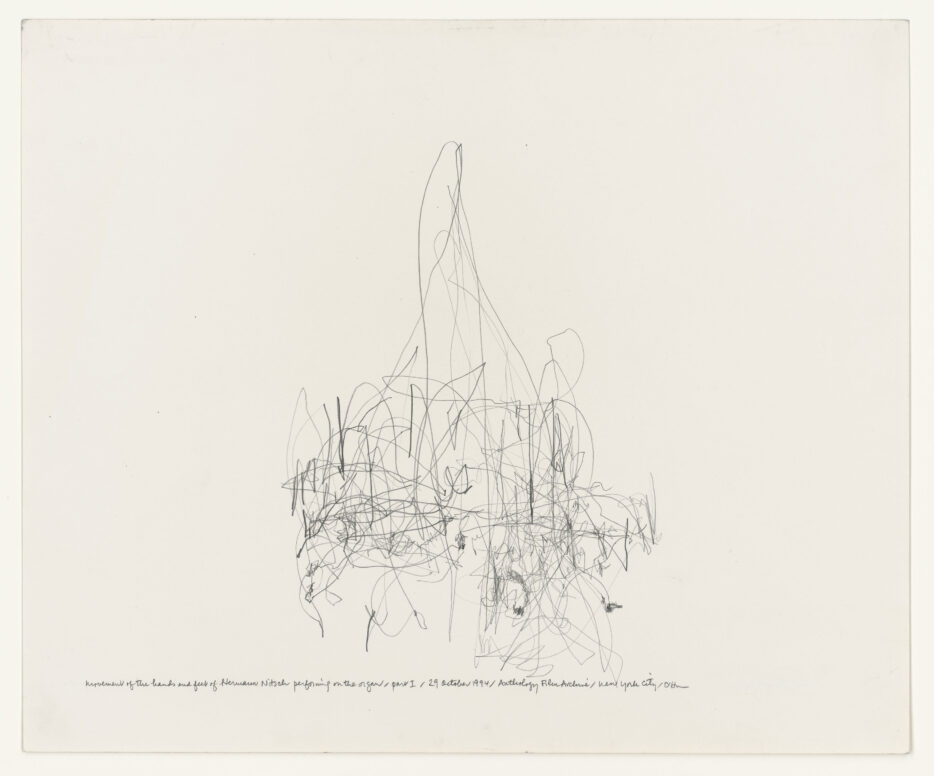
Morgan O'Hara, “Movement of Hermann Nitsch's Hands and Feet While Playing the Organ / Part I / October 29, 1994 / Anthology Film Archive, New York City”, from the series “Live Transmissions”, 1994, pencil on paper (Fabriano), 35.7 x 43.1 cm © VG Bild-Kunst, Bonn 2026
Photo: bpk / Kupferstichkabinett, SMB / Dietmar Katz

2/2
Morgan O'Hara, “Hand movement of pianist Cecil Taylor performing at The Knitting Factory, New York City / May 1996”, from the series “Live Transmissions”, 1996, pencil on paper (Fabriano), 35.7 x 43.1 cm © VG Bild-Kunst, Bonn 2026
Photo: bpk / Kupferstichkabinett, SMB / Dietmar Katz
In her drawings, the U.S. American artist Morgan O’Hara captures human movements through time and space. In 1981, she began working on the series Live Transmissions. She visited dance performances by Pina Bausch or the Merce Cunningham Dance Company, attended concerts and performances by artists such as Hermann Nitsch, or captured the workflows of artisans, scientists, or children at play.
In 1989, her drawing technique changed, and the artist began to draw with both hands, often holding up to 20 pencils simultaneously with both hands while capable of moving each pencil individually.
In Live Transmissions, O’Hara records the movements of performers in abstract line drawings that she creates during the performance. Through her special drawing technique, she translates what she sees into a dense, dynamic configuration of lines that is sometimes defined by soft and bright markings, at other times by hard markings and subtle color nuances.
O’Hara’s draftsmanship is based on the precise observation of what she sees: the movements of the dancers or the musicians nimbly playing their instruments. And yet the drawings should not be seen as documentations of an event but rather as independent works foregrounding the line and paying tribute to the performers’ achievements.
Newsletter
Contact & social networks
Schering Stiftung
Unter den Linden 32-34
10117 Berlin
Telefon: +49.30.20 62 29 65
Email: info@scheringstiftung.de
Opening hours
Project space
Thursday to Monday: 2 pm - 8 pm
Saturday to Sunday: 12 am - 8 pm
free entrance